
For years, I have stood in professional development sessions and leadership meetings recommending best practice strategies for multilingual learners. But recently, I’ve traded my full-time strategic leadership hat for a pair of Year 3 teacher shoes.
Returning to the daily rhythm of the classroom at St Joseph’s Institution International School has been a powerful reality check. While my titles – Head of EAL and Year 3 Class Teacher – might suggest a split personality, the two roles are actually in a constant, illuminating dialogue.
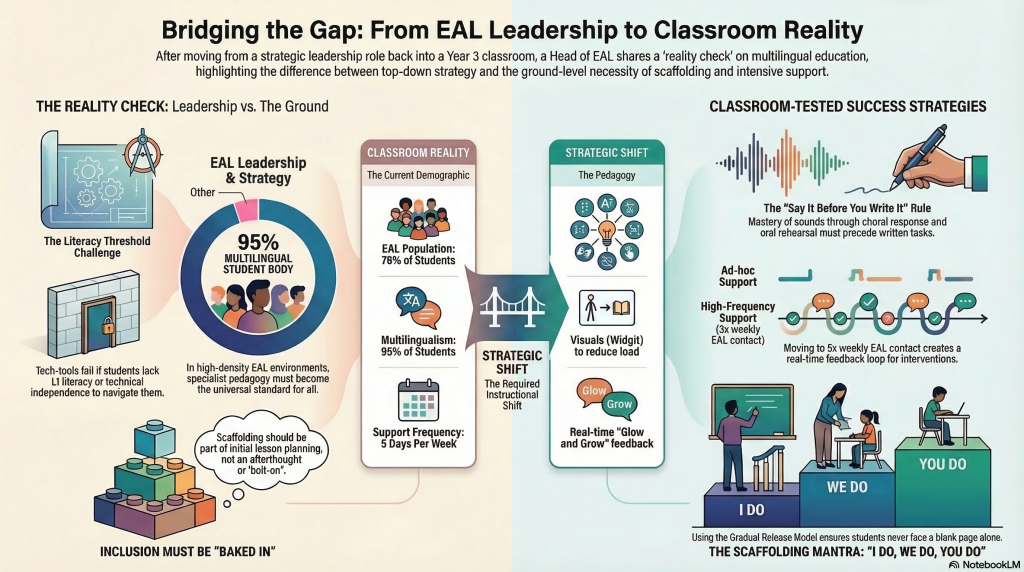
The Reality of the “Literacy Gap”
In leadership, it is easy to suggest translanguaging or tech-tools as a silver bullet. On the ground, I’ve been hit by the reality of the Literacy Threshold. Many of my Year 3 students are not yet literate in their home language (L1). (I’ve written about it in detail here.)
If a child cannot read in their first language and lacks the technical independence to navigate iPad dictation or Google Translate, those “best practice” bridges simply don’t exist yet. It has reminded me that we cannot assume tech-fluency; we have to build it alongside language.
Pedagogy for the 95%
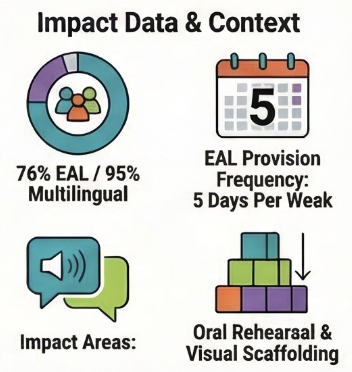
In my current year group, more than half of the students are EAL and 95% are multilingual. In this environment, EAL pedagogy isn’t a specialist add-on – it is just good pedagogy for everyone. My daily practice now leans heavily on:
- Oral Rehearsal: We say it before we write it. Using choral responses and “I say, you say” patterns ensures sounds are mastered before they ever hit the page.
- Visual Scaffolding: I’ve moved beyond simple text to visually enhanced substitution tables and Widgit symbols to reduce cognitive load.
- The Gradual Release Model: “I do, We do, You do” has become my mantra to ensure no student is left staring at a blank page.
The Power of High-Frequency Contact
One of the most impactful shifts we’ve made this year is doubling our EAL provision. By utilising Mandarin slots for our “New to English” and “Developing Competence” learners, we provide daily EAL input.
This intensity is a game-changer. Because I see these students up to 10 times a week and teach them core subjects like Science and IPC, I can notice a language struggle in a science experiment and turn it into a targeted EAL intervention the very next morning. It is a feedback loop that supports learners in real-time.
A Message for School Leaders
If my dual role has taught me anything, it is that inclusion must be baked in, not bolted on.
Even when our team is facing staffing challenges – like our current maternity cover in Key Stage 1 and my extra class teacher duties – we are empowering from a distance by involving EAL specialists in the initial planning stages. When scaffolds are part of the universal design of a lesson, every child has a seat at the table.
What startegies work best in your multilingual classrooms?